- Free result
- No sign-up
- Photo never uploaded
Face Shape Detector
Choose a front-facing photo and get a percentage for each of the 7 face shapes, with the lines we measured drawn on your face. The measuring happens in your browser and the photo is never uploaded.
Upload a photo
Drag and drop, or choose a file
JPG, PNG, WebP or HEIC
Your photo never leaves your device
- Camera at eye level, head straight
- Hair off your forehead and jaw
- Mouth closed, face relaxed
- Glasses and hat off
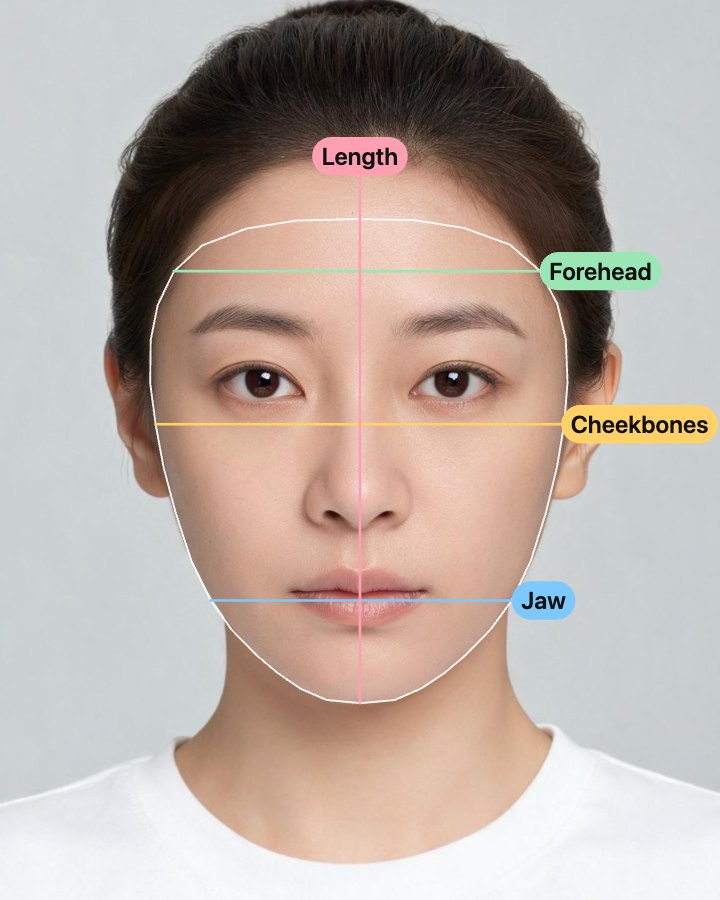 Forehead · cheekbones · jaw · length
What you get
Start with the free result. Upgrade only if you want the full picture.
Free result
$0- Your face shape and its % match
- A % match for all 7 shapes
- Why: the measurements behind it
- 3 quick tips for hair and glasses
Personal Style Guide
$4.99 once- 6 women's and 6 men's haircuts, each with the reason it suits your shape
- 4 haircuts to avoid
- 4 glasses frames that suit you, and 3 to avoid
- 4 beard styles
- Where to put contour, highlight and blush, and how to shape your brows
- Earrings, necklines and hats
- Printable, to take to your barber or stylist
Get your free result first, then upgrade from the result page.
How it works
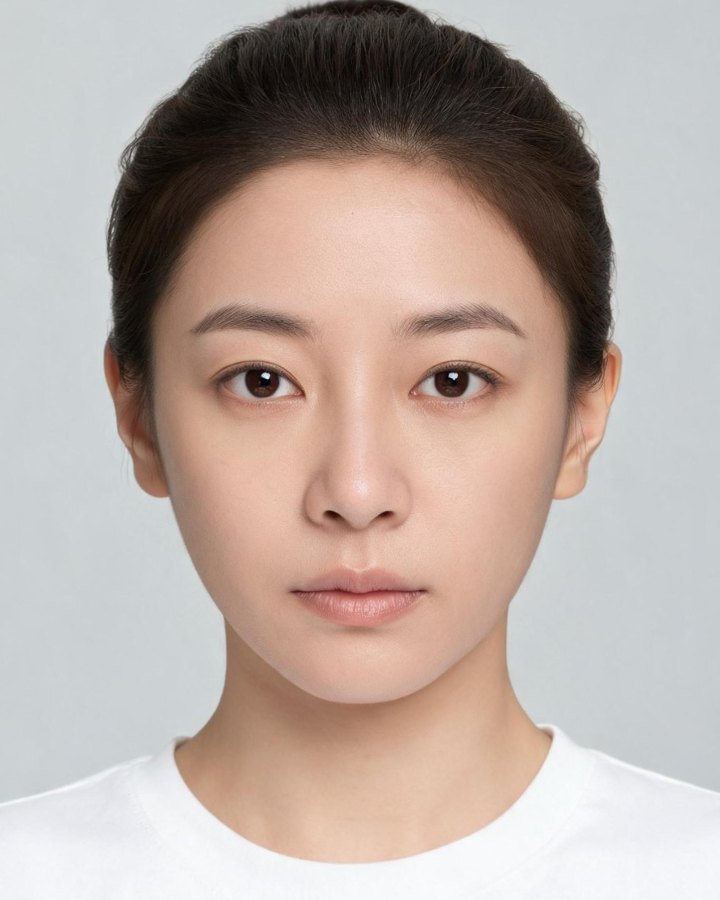
Pick a photo
Use a front-facing photo with your hairline and jawline in view. A photo someone else takes from a few feet away beats a close selfie.
Six measurements
MediaPipe places 478 points on your face and a hair model finds your hairline. From those we measure face length, forehead, cheekbone, jaw and chin width, and jaw angle.
Seven percentages
You get a match percentage for each shape, your top shape and runner-up, and the reasons in plain words. The measurement lines are drawn on your photo so you can check them.
What the detector measures
The detector takes six measurements from your photo.
- Face length, from hairline to chin. A hair model finds the hairline. If bangs, a hat or a shaved head hide it, we estimate where it is and the result says so.
- Cheekbone width, across the widest part of the face.
- Forehead width, across the temples.
- Jaw width, straight across between the two jaw angles.
- Chin width, which separates a broad chin from a pointed one.
- Jaw angle, measured at the corner of the jaw. A smaller angle means a sharper corner.
Length, forehead and jaw are each divided by cheekbone width, and chin by jaw width, so the size of your face in the photo doesn't matter.
The 478 points come from Google's MediaPipe face model. It tends to pull face widths toward the average, so two jaws that look clearly different in a mirror can measure only slightly apart. For that reason we define each shape against typical faces measured by the same model. Square, for example, means shorter than typical, with a jaw that is wider and more angular than typical.
The result gives a percentage for each of the 7 shapes, adding up to 100, and names the runner-up. It also lists the reasons, written like "Your face is 1.45× as long as it is wide (a typical length)", and draws the lines we measured over your photo.
The seven shapes
Each shape is defined by how it differs from a typical face. "Typical" comes from our calibration set of 40 public-domain studio headshots, and the last column shows how many of them landed in each shape.
| Shape | Length vs. typical | Widths and jaw | Of our 40 |
|---|---|---|---|
| Oval | A little long | Forehead a little wide, jaw a little narrow, soft jaw | 14 |
| Round | Much shorter | Jaw a little wide, very soft jaw | 2 |
| Square | Shorter | Wide, angular jaw | 7 |
| Oblong | Much longer | Typical widths and jaw | 5 |
| Heart | Typical | Wide forehead, narrow jaw, pointed chin | 4 |
| Diamond | A little long | Narrow forehead and jaw, so the cheekbones lead | 2 |
| Triangle | A little short | Narrow forehead, wide jaw, slightly angular | 6 |
Oval sits closest to typical, so faces without a strong lean in any direction land there. Forty headshots is a small sample, so the counts describe that set only.
Length carries the most weight. The median face in the set was 1.43 times as long as it was wide, and the middle half fell between 1.37 and 1.49. Your result calls a face longer than most above about 1.51, and shorter and wider than most below about 1.35.
Neighboring shapes share a trait. Round and square are both short and differ mainly at the jaw angle. Square and triangle both have a wide jaw. Heart and diamond both narrow toward the chin. When your top two shapes are close, choose styles that work for both.
Haircuts and frames by shape
The usual approach is to balance whatever proportion stands out. Height on top adds length, and width at the sides takes it away. Round frames soften an angular jaw, and angular frames give a soft face some structure.
- Oval: most lengths work. Keep the cheekbones visible, and pick frames about as wide as the cheekbones.
- Round: lift at the crown and length past the chin. Rectangular or upswept frames a little wider than the cheeks.
- Square: soft layers or waves that fall past the jaw. Round, oval or aviator frames.
- Oblong: bangs and width at the sides, with little height on top. Deep or oversized frames.
- Heart: side-swept or curtain bangs, with fullness at chin level. Aviators, ovals or rimless frames, and no heavy browline.
- Diamond: bangs to widen the forehead and fullness at the chin, with no extra volume at the cheekbones. Cat-eye, oval or browline frames.
- Triangle: volume at the crown and temples, and no length that stops right at the jaw. Browline, cat-eye or semi-rimless frames.
Beards work the same way. Length at the chin makes a round or square face look longer. Fuller sides widen a long face. A defined edge adds angle to a soft jaw, and a rounded bottom softens a square one.
Your free result has three tips for your top shape. The Personal Style Guide ($4.99) names specific cuts, frames and beard styles for that shape, with reasons, and prints so you can bring it to the barber or salon.
Checking with a tape measure
To check by hand, use a soft tailor's tape and a mirror. Pull your hair back and hold the tape flat and straight across, since wrapping it around the curve adds width.
- Cheekbones: across the widest point, usually just below the outer corners of the eyes.
- Jaw: straight across between the jaw angles, the corners below and a little in front of the earlobes.
- Forehead: temple to temple, a little above the eyebrows.
- Length: from the middle of the hairline straight down to the bottom of the chin. If your hairline has receded, start where the forehead begins to curve back.
Note which width is largest and how much longer your face is than it is wide, then compare that with the table above. A face only a little longer than wide points to round or square, and the jaw corner decides between them.
Your tape ratio will differ from the number on your result, because the tape lands on slightly different points and the model narrows width differences. The tape is good for two things: which width is largest, and how clearly long or short your face is. Measure each width twice, and again if the readings differ by more than a quarter inch.
What throws the result off
Before measuring, the detector flags a turned or tilted head, a smile, closed eyes, blur, poor exposure, extra faces and a face too small to measure. These still affect the result:
- Hidden hairline. With bangs, a hat or a shaved head, we estimate the hairline and the result says so. Round, square and oblong depend most on length, so give them less weight in that case.
- Receding hairline. We measure from where the hair starts, which can make a face read longer. If oblong wins, read the runner-up too.
- Full beard. It covers the jaw angles, so the jaw can read wider or softer than the bone underneath. A trimmed or clean-shaven photo is clearer.
- Close selfie. At arm's length the lens enlarges the middle of the face and shrinks the sides. Have someone take the photo from a few feet away, or use the 2× lens.
If a result looks wrong, look at the lines on your photo first. A hairline drawn too low, or a jaw line sitting on a beard, tells you what to retake.
Where your photo goes
Both models run in your browser: the MediaPipe face model and a hair-segmentation model. They download on your first visit, about 8 MB together, and after that the measuring happens on your phone or computer. Our server has no way to receive a photo.
You can check this. Open your browser's developer tools, choose the Network tab and run the detector. The model files come in. Nothing goes out.
If you buy the Personal Style Guide, your photo and measurements stay in your own browser for up to 7 days, so the guide is still there when you come back from checkout. "Delete my data" removes them at any time. Stripe takes the payment and never sees the photo. More in the privacy policy.
Frequently asked questions
Is the face shape detector free?
Yes. Your top shape, the percentage for all 7 shapes, the reasons, the measurement lines and three quick tips are free, with no account. The Personal Style Guide is an optional one-time purchase of $4.99.
How reliable is the result?
Most of the uncertainty comes from the photo and from faces that sit between two shapes. A hidden hairline, a beard or a close selfie can move the result. Run two or three good photos. If the same shape leads each time, go with it.
What is the most common face shape?
In our 40 calibration portraits, oval was the most common with 14, then square with 7 and triangle with 6. Round and diamond had 2 each. Oval sits closest to typical proportions, so it collects faces with no strong lean. Forty headshots is too few to speak for everyone.
My top two shapes are close. Which one am I?
Treat yourself as both. Read the reasons on your result and notice which trait stands out in the mirror, such as a sharp jaw or a long face. Choose haircuts and frames that suit both shapes, and lean toward the one with that trait when the advice conflicts.
Does it work if I have a beard?
Yes, with less certainty at the jaw. A full beard covers the jaw angles, so your jaw can read wider or softer than it is. A trimmed or clean-shaven photo gives the clearest result. The Personal Style Guide includes 4 beard styles for your shape.
What if I have bangs or a shaved head?
We estimate where your hairline would sit from the rest of your face, and the result notes that it was estimated. Face length is less certain then, so round, square and oblong deserve a little less weight. Pulling bangs back gives a better reading.
Should I take off my glasses for the photo?
Yes, if you can. Thick frames sit over the temples, which is where forehead width is measured, and they can hide the brow area. Thin wire frames usually cause no trouble, but a photo without glasses removes the doubt.
Can my face shape change?
Bone structure changes little in adulthood, but the outline in a photo can. Weight changes alter fullness at the cheeks and jaw, the jawline softens with age, and a beard or new haircut changes what shows. After a big change, try a new photo.
Does it work on a phone?
Yes, in a current browser on iPhone or Android, with nothing to install. The first visit downloads the face and hair models, about 8 MB. Older phones take a little longer because all of the work happens on the device.
Can I get a refund on the style guide?
Yes, within 14 days. Write to support and we'll return the full $4.99. The guide opens on the same page right after checkout, so you can read it and print it before you decide.
Find your face shape now
Free, takes a few seconds, and your photo never leaves your device.
Upload a photoPersonal Style Guide: $4.99 one-time, optional